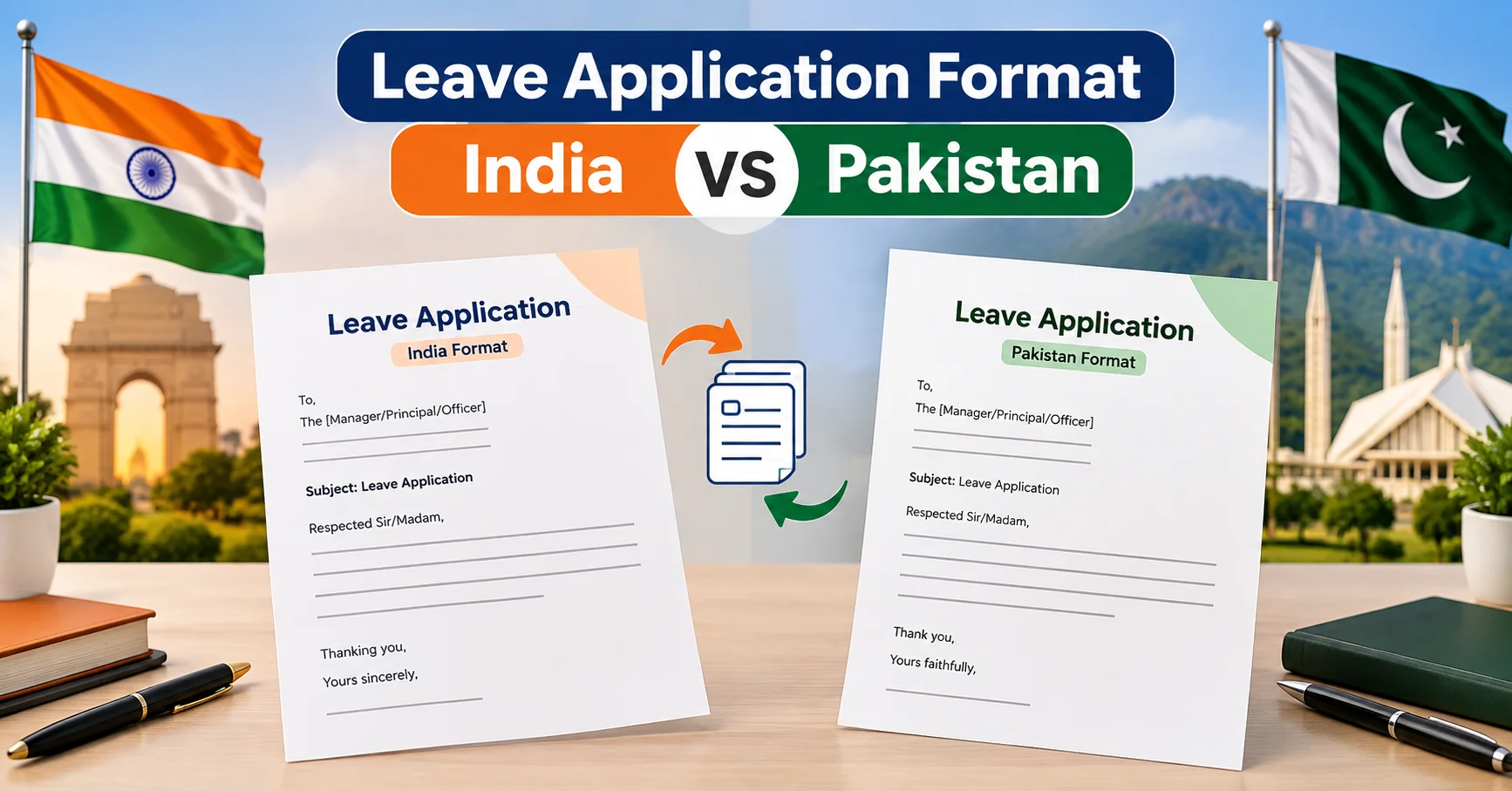
| Format | 🇮🇳 India | 🇵🇰 Pakistan |
|---|---|---|
| Typical recipient | Principal, class teacher, manager, HR, head of office or another authorized authority. | Principal, head of institution, manager, HR, head of office or another authorized authority. |
| Subject line | Usually “Application for Leave” or a reason-specific subject such as “Leave Application for Personal Work.” | Usually “Application for Leave” or a reason-specific subject. Government requests may identify the leave category. |
| Common applicant details | Name, class/course or designation, department, institution/office and contact details when requested. | Name, class/course or designation, department, institution/office and contact details when requested. |
| Leave dates | State the exact start date, end date and expected return/joining date. | State the exact start date, end date and expected return/joining date. |
| Reason wording | Keep the reason truthful and concise. Add supporting documents only when the relevant authority requires them. | Keep the reason truthful and concise. For government service, use the applicable leave category and follow the competent authority’s procedure. |
| Government context | The CCS (Leave) Rules, 1972 are a Central Government framework for covered civilian employees; they do not automatically govern every employee or every institution in India. | Pakistan’s federal Revised Leave Rules, 1980 contain a specific category called Leave ex-Pakistan for eligible civil servants spending leave abroad. |
| Foreign travel wording | When going abroad on leave, applicable permission requirements can depend on cadre/department instructions; the leave application should state the purpose of going abroad where required. | Where applicable, the application/approval can refer to Leave ex-Pakistan and the intended foreign destination, subject to the governing service rules and competent authority. |
| Signature and closing | Polite request, applicant name, class/designation and signature/date where required. | Polite request, applicant name, designation/class and signature/date where required. |
Quick Answer
The basic leave letter format is similar in India and Pakistan: address the right authority, state who you are, give the reason briefly, specify the leave dates, mention your return date and request approval. The important difference appears in country-specific government service rules and terminology. In India, the CCS (Leave) Rules, 1972 apply to covered Central Government civilian employees. In Pakistan's federal framework, Leave ex-Pakistan is an expressly named leave category for eligible civil servants spending leave abroad.
India vs Pakistan: What Actually Changes in a Leave Letter?
For ordinary school, college and office requests, the structure is more similar than different. A well-written application normally identifies the recipient, applicant, dates, reason, expected return and request for approval. The biggest practical difference is not the basic paragraph order; it is the terminology and approval process attached to a specific institution or government service.
What stays the same
- Use the correct recipient and designation.
- Keep the subject specific enough to identify the request.
- Use exact leave dates rather than “for a few days.”
- State the expected joining or return date.
- Keep the reason concise and truthful.
- Add supporting documents, handover details or contact information when the institution requires them.
What can change
India and Pakistan do not have one universal leave policy covering every worker. Schools, colleges, private employers, state/provincial governments and federal civil services can use different forms and approval chains. That is why this hub compares format and terminology rather than treating one template as legally mandatory in both countries.
Important: The government-rule references on this page are for context, not a substitute for your institution’s current leave form or service instructions. Check the rule set that actually governs your employment or study situation.
CCS Leave Rules vs Ex-Pakistan Leave Rules
This is where the phrase “CCS leave rules vs Ex-Pakistan leave rules” can be confusing. They are not two interchangeable names for the same type of leave.
| Point | India | Pakistan |
|---|---|---|
| Rule framework | Central Civil Services (Leave) Rules, 1972 for covered Central Government civilian employees. | Revised Leave Rules, 1980 for the federal civil-service framework, with other rules applying where relevant. |
| Foreign leave terminology | Foreign travel during leave can involve permission requirements and department/cadre instructions; the application should contain the purpose of going abroad where required. | Leave ex-Pakistan is an express leave category for eligible civil servants intending to spend leave abroad, including Hajj or Umrah under the cited rule. |
| Who is covered? | Not every employee in India. State, private, school, college and other employees may follow different rules. | The cited Revised Leave Rules are the federal civil-service framework; provincial arrangements can be governed by their own applicable rules/instructions. |
| Application takeaway | Use the institution’s actual leave category and approval route. | When the federal service rules apply and the leave is spent abroad, use the correct “Leave ex-Pakistan” terminology where appropriate. |
Primary references: Department of Personnel & Training, Government of India; Ministry of Finance, Government of Pakistan - Revised Leave Rules, 1980; Pakistan Establishment Division - 2023 leave delegation memorandum.
Fields to Leave Blank in a Sample Leave Application
For a reusable template, do not hard-code personal information. Leave these fields open so the same sample can be copied for different users and situations:
| Field | Use it for | Typical placeholder |
|---|---|---|
| Name | Student, employee or applicant identity | [Full Name] |
| Address | Home or correspondence address when needed | [Address] |
| Phone / Contact | Contact during leave when required | [Phone Number] |
| Designation / Class | Job title, BPS, class, course or year | [Designation / Class] |
| Department / Institution | Office, school, college or department | [Department / Institution] |
| Leave category | Casual, earned, sick, personal, ex-Pakistan or other applicable category | [Leave Category] |
| Leave dates | Requested absence period | [Start Date] to [End Date] |
| Return date | Expected joining / attendance date | [Return Date] |
| Reason | Short, truthful purpose | [Reason] |
| Handover / pending work | Useful for office applications | [Handover Details] |
| Destination country | Useful for foreign travel requests if the office requires it | [Country] |
| Signature / date | Final submission details | [Signature] / [Date] |
India Leave Application Samples
These samples are intentionally blank in the personal-detail fields. They can be adapted for schools, colleges, offices and government contexts without assuming that every institution uses the same form.
One-Day Leave
Simple format for a student requesting one day of leave.
To,
[Principal / Class Teacher]
[School / College Name]
[City]
Date: [Date]
Subject: Application for One Day Leave
Respected Sir/Madam,
I am [Full Name], a student of [Class / Course]. I respectfully request leave for [Leave Date] due to [Reason].
I will attend classes again on [Return Date]. Kindly grant me leave for the requested day.
Yours obediently,
[Full Name]
[Class / Roll No.]
Phone: [Phone Number]
Address: [Address]
Signature: [Signature]
Personal Work
Professional office format with optional contact and handover fields.
To,
[Manager / HR / Competent Authority]
[Company / Department]
[City]
Date: [Date]
Subject: Leave Application for Personal Work
Respected Sir/Madam,
I am [Full Name], working as [Designation] in [Department]. I request leave from [Start Date] to [End Date] due to [Reason].
I will return to work on [Return Date]. Before proceeding on leave, I will complete or hand over urgent work to [Handover Person / Team].
Kindly approve my leave.
Regards,
[Full Name]
[Employee ID - optional]
Phone: [Phone Number]
Address: [Address]
Signature: [Signature]
Pakistan Leave Application Samples
These samples follow the same clear letter logic while leaving country-specific approval and service-rule fields open for the relevant institution.
Personal / Casual Leave
General office format; select the correct leave category according to the employer’s policy.
To,
[Manager / HR / Competent Authority]
[Organization / Department]
[City]
Date: [Date]
Subject: Application for Leave - [Leave Category]
Respected Sir/Madam,
I, [Full Name], working as [Designation] in [Department], request leave from [Start Date] to [End Date] on account of [Reason].
I will resume duty on [Return Date]. Any urgent work will be completed or handed over as required.
Kindly sanction the requested leave.
Yours faithfully,
[Full Name]
[BPS / Designation - if applicable]
Phone: [Phone Number]
Address: [Address]
Signature: [Signature]
Leave ex-Pakistan
Use this only where the applicable federal service rules and approval procedure apply.
To,
[Competent Authority]
[Ministry / Division / Department]
[City]
Date: [Date]
Subject: Application for Leave ex-Pakistan
Respected Sir/Madam,
I, [Full Name], [Designation / BPS], posted in [Department / Office], request leave ex-Pakistan from [Start Date] to [End Date].
The proposed destination is [Country] and the purpose of travel is [Purpose]. I intend to resume duty on [Return Date].
Kindly consider and sanction the leave in accordance with the applicable rules and approval procedure.
Yours faithfully,
[Full Name]
[Designation / BPS]
Department: [Department]
Phone: [Phone Number]
Address: [Address]
Signature: [Signature]
Need a ready-to-submit letter?
Use LeaveDraft to create a leave application and customize the applicant, dates, reason and recipient.
Open Leave Application GeneratorFrequently Asked Questions
Editorial note: This page intentionally separates general letter-writing structure from country-specific service rules. For a live application, follow the current form or instructions issued by your school, college, employer, department or competent authority.